Mission & Impact

Vision
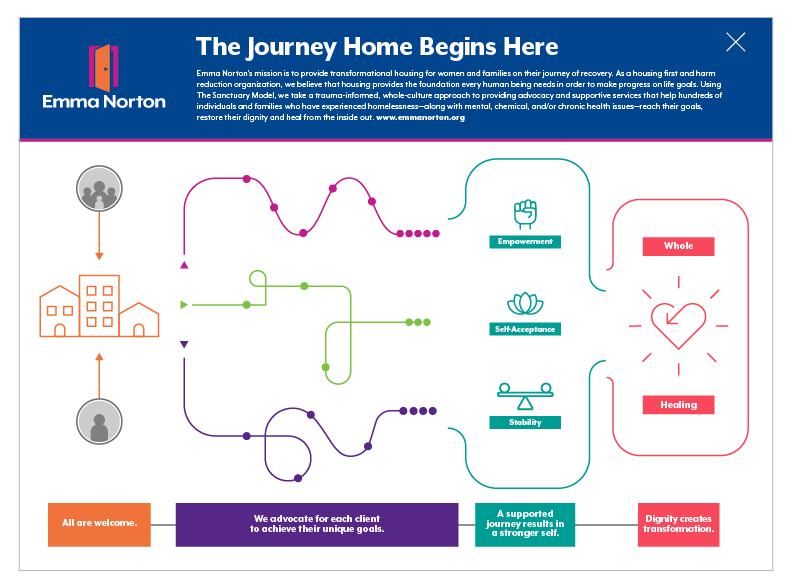
Emma Norton Services is a trauma-informed organization that promotes healing and recovery through a full array of exemplary housing and services.
Mission
We connect people to transformational housing, growth, and possibility— realized through their own design— in support of their journey of recovery.
Values
- Embracing Humanity
- Cultivating Community
- Sparking Creativity
- Inspiring Joy
Goals
- Provide safe, secure, affordable housing for women, individuals, and families in transition.
- Provide support, advocacy and referrals to community services for individuals and families to stabilize their lives, build confidence and enable self-sufficiency.
- Use our collective power to build collaborative communities and partnerships to achieve systemic change.
- Raise awareness of our programs to better serve individuals and families in need.
- Through radical compassion and radical acceptance, provide a comprehensive array of services that foster harmony, wholeness and completeness.
- Create inclusive environments that support empowerment, diversity, innovation and adaptability to promote healing.
Outcomes
The programs at Emma Norton have consistently successful outcomes. Every individual journey of recovery is unique, and across our organization we can measure the direct impacts we’ve had on moving those journeys toward wholeness. We know every little victory is a part of a success story worth celebrating.
Healing by the Numbers
Our programs have shown again and again that they are effective models to move our most vulnerable community members toward safe, stable housing, which provides a foundation for greater individual stability and wellbeing. In 2025, we served 355 individuals, with 69 percent identifying as persons of color and all very low income. Additionally, 65 percent of participants identified as female, 29 percent identified as male, and 6 percent identified as non-binary or genderfluid. See below for additional outcome measurements for 2025.
Restoring Waters outcomes :
- 93% of clients stayed at Restoring Waters for 12 months or more or exited to safe, affordable housing of their choice.
- 98% of clients participated in onsite programming to support their mental health or wellbeing.
Emma’s Place outcomes:
- 100% of families moved to permanent, affordable housing at exit.
- 95% of adults created a stability plan and actively worked toward completing at least one goal.
- Over 100 youth (98%) participated in youth activities and programming.
Scattered-Site program:
- 92% of tenants successfully completed their initial lease period upon moving into their own rental units.
- 100% of households experiencing a crisis that potentially affected their housing stability received support to resolve it.
Sanctuary Model
The Sanctuary Model is a trauma-informed, evidence-supported approach to creating and sustaining nonviolent lives and organizations that work toward healing and wholeness for all of humanity. This model informs not just our services, but the culture of the staff, board, and community.
Using the principles of the Sanctuary Model empowers staff with the emotional and social skills needed to serve people effectively with radical compassion, and model healthy responses to stress for the individuals and families they work with.
-
Sanctuary Model
Commitment to help
-
Nonviolence
Build safety skills and a commitment to higher purpose
-
Social Responsibility
Rebuild connection skills, establish healthy attachment styles, and sense of fair play & justice
-
Democracy
Create civic skills of self-control & discipline, and administration of healthy authority
-
Growth & Change
Work through loss and prepare for the future
-
Social Learning
Build cognitive and social skills
-
Open Communication
Learn conflict management, reduce acting out, enhance self-correction
-
Emotional Intelligence
Teach and grow emotional management skills
Sanctuary Model
Commitment to help
Nonviolence
Build safety skills and a commitment to higher purpose
Social Responsibility
Rebuild connection skills, establish healthy attachment styles, and sense of fair play & justice
Democracy
Create civic skills of self-control & discipline, and administration of healthy authority
Growth & Change
Work through loss and prepare for the future
Social Learning
Build cognitive and social skills
Open Communication
Learn conflict management, reduce acting out, enhance self-correction
Emotional Intelligence
Teach and grow emotional management skills